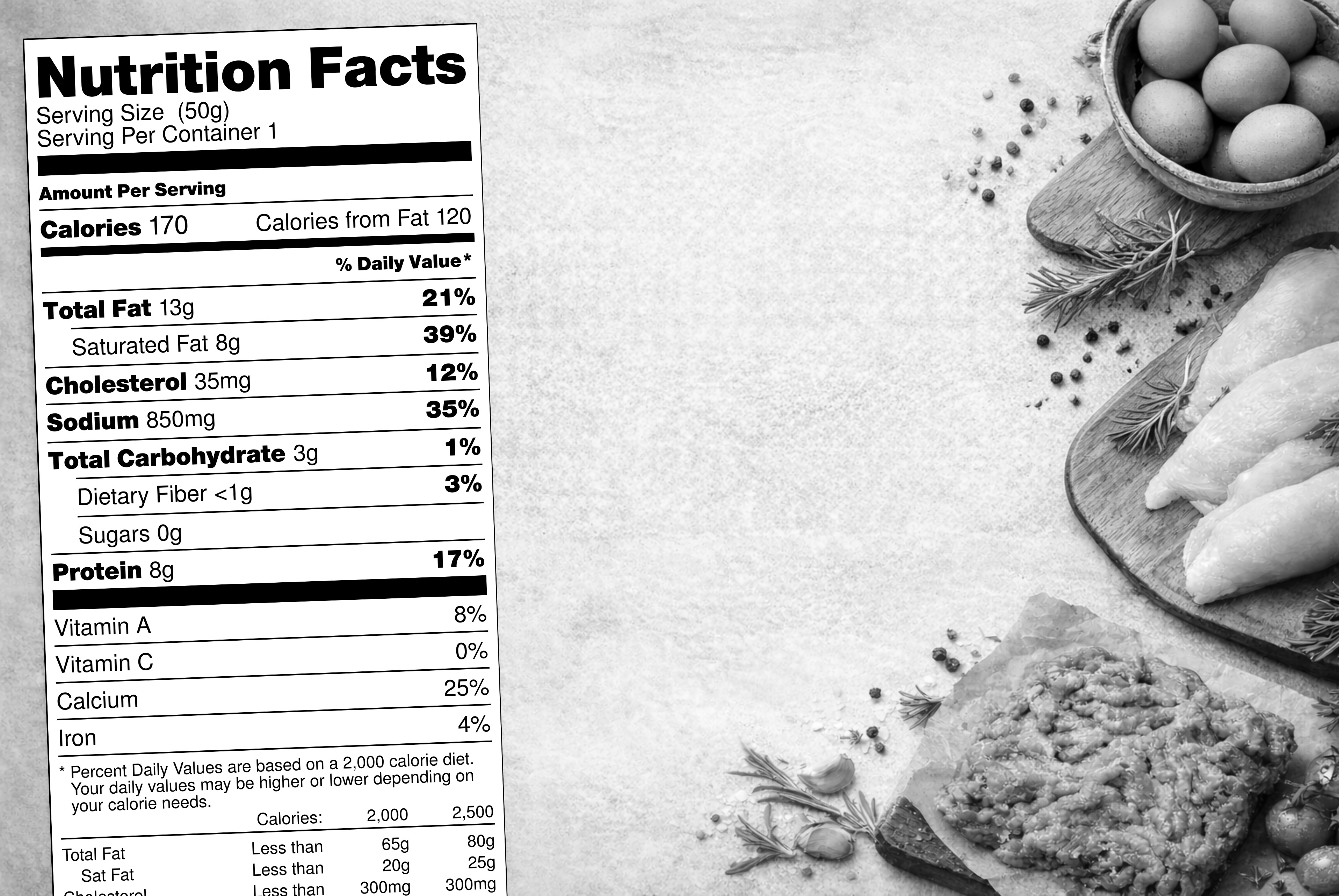
USDA - FSIS Nutrition Facts Labels: What You Need to Know
The Basics: Who Regulates What?
In the U.S., food labeling is regulated by two federal agencies: the Food and Drug Administration (FDA) and the Food Safety and Inspection Service (FSIS), which is part of the U.S. Department of Agriculture (USDA).
While the FDA updated its labeling requirements in 2016, the USDA - FSIS still allows the use of the original 1990 Nutrition Facts Panel, so products regulated under the USDA can use either format until the USDA updates its regulations to align with the FDA.
Which Products are Regulated by the USDA - FSIS?
While the majority of food products in the U.S. are regulated by the FDA, there are specific products that fall under the USDA - FSIS, including:
- Meat and meat products
- Poultry products
- Processed egg products (liquid, frozen, or dried)
- Products that contain more than 3% raw meat or poultry meat
- Products that contain more than 2% cooked meat or poultry meat
If your product is regulated by the FDA (including dairy, most seafood, game meats, and supplements, among many others), you’ll be required to use the 2016 nutrition fact panel format instead.
Key Features of the USDA - FSIS 1990 Label Format
Required Nutrients (9 CFR 317.309(c))
- Calories
- Calories from fat
- Total fat
- Saturated fat
- Cholesterol
- Sodium
- Total carbohydrate
- Dietary fiber
- Sugars
- Protein
- Vitamins and minerals (Vitamin A, Vitamin C, Calcium, Iron)
Voluntary Nutrients Include:
- Calories from saturated fat
- Polyunsaturated fat
- Monounsaturated fat
- Stearic acid
- Potassium
- Sugar alcohol
- Soluble/insoluble fiber
- Other carbohydrates
Formatting and Font Rules (9 CFR 317.309(d))
- Uses Helvetica Black/Regular, mostly 6pt or 8pt
- No bolded section headers or oversized calorie values like in 2016 format
- Uniform font size, tighter kerning
- Different footnote options
Daily Values (DV’s)
- Daily Value percents are based on 1990 RDIs and DRVs, not the updated 2016 values
Serving Size
- Until the USDA - FSIS updates the required Reference Amounts Customarily Consumed (RACCs) used for Serving Sizes, the original RACCs must be used.
- The RACCs for meat and poultry products can be found in 9 CFR 317.312 and 9 CFR 381.412
Rounding and Reporting Rules
USDA’s 1990 label has strict rounding rules for nutrient amounts (9 CFR 317.309(c)):
- Calories and Calories from Fat:
amount < 5cal - express as 0
amount ≤ 50 cal - express to nearest 5 cal increment
amount > 50 cal - express to nearest 10 cal increment
- Total Fat and Saturated Fat
amount < 0.5 g - express as 0
amount < 5 g - express to nearest .5 g increment
amount ≥ 5 g - express to nearest 1 g increment
- Cholesterol
amount < 2 mg - express as 0
amount 2-5 mg - express as "less than 5 mg"
amount > 5 mg - express to nearest 5 mg increment
- Sodium
amount < 5 mg - express as 0
amount 5-140 mg - express to nearest 5 mg increment
amount > 140 mg - express to nearest 10 mg increment
- Dietary Fiber, Sugars and Total Carbohydrates
amount < 0.5 g - express as 0
amount < 1 g - express as “Contains less than 1 g” or “less than 1 g”
amount ≥ 1 g - express to nearest 1 g increment
- Protein
amount < 0.5 g - express as 0
amount < 1 g - express as “Contains less than 1 g” or “less than 1 g”
or to 1 g if .5 g to < 1 g
amount ≥ 1 g - express to nearest 1 g increment
- % Daily Values for Mandatory Nutrients should be expressed to the nearest 1% DV increment
- % Daily Values for Vitamins and Minerals (except potassium):
< 2% of RDI may be expressed as 2% DV if actual amount is 1% or more or 0 otherwise
≤10% of RDI - express to nearest 2% DV increment
> 10%-50% of RDI - express to nearest 5% DV increment
> 50% of RDI - express to nearest 10% DV increment
Why Use a Label Approved in 1990?
The USDA-FSIS 1990 nutrition facts label format may seem outdated, especially with the FDA’s newer 2016 label now used as the standard for most food products. But in the world of USDA-regulated items like meat, poultry, and egg products, this original format is still in active use.
For many manufacturers, the 1990 label is preferred for continuity, simplicity, or regulatory alignment. It may match legacy packaging templates, simplify QA processes, or serve specific markets that are accustomed to the older layout.
That said, there are growing signs that USDA may eventually phase out the 1990 format in favor of the more modern 2016 version. While no formal timeline has been announced, manufacturers are watching this closely, and so are we. However, even if a regulation change comes, it could still be several years before it takes full effect.
Create USDA - FSIS 1990 Labels with ENTR
USDA - FSIS 1990-style Nutrition Facts Panels are now live in ENTR. Here’s what you can do:
- Automatically apply accurate formatting, layout, and nutrients
- Display required nutrient declarations based on USDA RDIs and DRVs
- Export panels in multiple download formats
- Generate compliant ingredient statements
- Choose between 1990 and 2016 formats for eligible products
Whether you're labeling a smoked sausage, chicken tender, or egg patty, ENTR helps ensure your panels meet the right regulatory requirements.
Want a walkthrough of ENTR’s labeling options? Contact us to learn more.
.png)